
第1問
$0\leqq k\leqq n$のとき \[P(n,k)={}_nC_k\left(\frac{1}{n}\right)^k\left(\frac{n-1}{n}\right)^{n-k}\]
(1)
$$ \begin{aligned} \frac{P(n,k+1)}{P(n,k)}&=\frac{k!(n-k)!}{(k+1)!(n-k-1)!}\cdot\frac{1}{n}\cdot\frac{n}{n-1}\\ &=\frac{n-k}{k+1}\cdot\frac{1}{n-1}\\ &\leqq\frac{n-1}{k+1}\cdot\frac{1}{n-1}\\ &=\frac{1}{k+1}\lt1\quad(\because k\geqq 1) \end{aligned} $$
$\therefore P(n,k)\gt P(n,k+1)$
(2)
$Q(0)=\dfrac1e$
$k\geqq 1$のとき、$n\geqq k$となる任意の$n$に対し、 \[\begin{aligned} P(n,k)&={}_nC_k\left(\frac{1}{n}\right)^k\left(1-\frac{1}{n}\right)^{n-k}\\ &=\frac{n(n-1)\cdots(n-k+1)}{k!}\cdot\frac{1}{n^k}\cdot\left(1-\frac{1}{n}\right)^n\left(1-\frac{1}{n}\right)^{-k}\\ &=\frac{1}{k!}\cdot\dfrac{n}n\cdot\frac{n-1}{n}\cdots\frac{n-k+1}{n}\cdot\left(1-\frac{1}{n}\right)^n\left(1-\frac{1}{n}\right)^{-k}\\ \end{aligned}\]
$\therefore Q(k)=\dfrac{1}{k!e}$
$k=0,1$のときに限り、$Q(k)$は最大となり、その値は$\dfrac1e$である。
第2問
(1)
\[\begin{aligned} f'(x)&=\frac{x^2+1-2x^2}{(x^2+1)^2}\\ &=\frac{1-x^2}{(x^2+1)^2} \end{aligned}\]
\[\begin{aligned} f^{\prime\prime}(x)&=\frac{-2x(x^2+1)^2-(1-x^2)\cdot2(x^2+1)\cdot2x}{(x^2+1)^4}\\ &=\frac{-2x(x^2+1)-4x(1-x^2)}{(x^2+1)^3}\\ &=\frac{2x(-x^2-1-2+2x^2)}{(x^2+1)^3}\\ &=\frac{2x(x^2-3)}{(x^2+1)^3} \end{aligned}\]
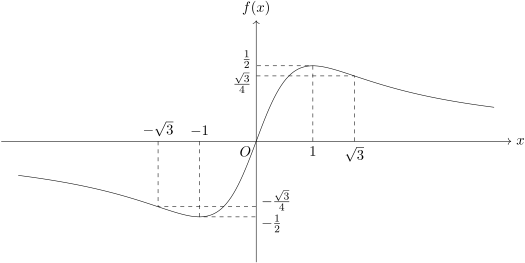
よって、増減、極値、凹凸は次のようになる。 $$ \begin{array}{|c|c|c|c|c|c|c|c|c|c|c|c|} \hline x & \cdots & -\sqrt{3} & \cdots & -1 & \cdots & 0 & \cdots & 1 & \cdots & \sqrt{3} & \cdots \\ \hline f'(x) & – & – & – & 0 & + & + & + & 0 & – & – & – \\ \hline f^{\prime\prime}(x) & – & 0 & + & + & + & 0 & – & – & – & 0 & + \\ \hline f(x) & \begin{matrix} \searrow \\ \text{上に凸} \end{matrix} & -\dfrac{\sqrt{3}}{4} & \begin{matrix} \searrow \\ \text{下に凸} \end{matrix} & -\dfrac{1}{2} & \begin{matrix} \nearrow \\ \text{下に凸} \end{matrix} & 0 & \begin{matrix} \nearrow \\ \text{上に凸} \end{matrix} & \dfrac{1}{2} & \begin{matrix} \searrow \\ \text{上に凸} \end{matrix} & \dfrac{\sqrt{3}}{4} & \begin{matrix} \searrow \\ \text{下に凸} \end{matrix} \\ \hline \end{array} $$
変曲点は、$\left(\pm\sqrt3,\pm\dfrac{\sqrt3}4\right)$、$(0,0)$である(複号同順)。
グラフは、次のようになる。
(2)
$x=\pm1$における接線は$y=\pm\dfrac12$である(複合同順)から、$x$軸と交わらない。
Pの座標を$\left(p,\dfrac{p}{p^2+1}\right) (p\neq\pm1)$とする。
$x=p$における接線の式は、次のようになる。 \[\begin{aligned} y&=\frac{1-p^2}{(p^2+1)^2}(x-p)+\frac{p}{p^2+1}\\ &=\frac{1-p^2}{(p^2+1)^2}x+\frac{2p^3}{(p^2+1)^2} \end{aligned}\]
これが点$(a,0)$を通る。 \[\begin{aligned} \iff&\frac{1-p^2}{(p^2+1)^2}a+\frac{2p^3}{(p^2+1)^2}=0\\ \iff&(1-p^2)a+2p^3=0\\ \iff&a=\dfrac{2p^3}{p^2-1} \quad(\because p\neq \pm1) \end{aligned}\]
よって、求める個数は、$p$の方程式$a=\dfrac{2p^3}{p^2-1}$の解の個数である。
$g(x)=\dfrac{2x^3}{x^2-1}$とする。 $$ \begin{aligned} g'(x)&=\frac{6x^2(x^2-1)-2x^3\cdot2x}{(x^2-1)^2}\\ &=\frac{2x^2(3x^2-3-2x^2)}{(x^2-1)^2}\\ &=\frac{2x^2(x-\sqrt3)(x+\sqrt3)}{(x^2-1)^2} \end{aligned} $$から、$g$の増減は次のようになる。 $$ \begin{array}{|c|c|c|c|c|c|c|c|c|c|c|c|} \hline x & \cdots & -\sqrt{3} & \cdots & -1 & \cdots & 0 & \cdots & 1 & \cdots & \sqrt{3} & \cdots \\ \hline g’ & + & 0 & – & \times & – & 0 & – & \times & – & 0 & + \\ \hline g & \nearrow & -3\sqrt{3} & \searrow & \times & \searrow & 0 & \searrow & \times & \searrow & 3\sqrt{3} & \nearrow \\ \hline \end{array} $$
また、 $$ \begin{aligned} \lim_{x\to\pm\infty}g(x)&=\pm\infty\\ \lim_{x\to\pm1-0}g(x)&=-\infty\\ \lim_{x\to\pm1+0}g(x)&=\infty \end{aligned} $$ である。
よって、求める個数は、次のようになる。
- $a\gt 3\sqrt3$のとき、3個。
- $a=3\sqrt3$のとき、2個。
- $0\lt a\lt 3\sqrt3$のとき、1個。
第3問
実数$x$に対し、$(x-\sin x)’=1-\cos x\geqq 0$から、$x-\sin x$は単調増加である。
また、$0-\sin 0=0$である。
$\therefore x\geqq 0$ならば$x-\sin x\geqq 0$。$\cdots ①$
(1)
Qを通り、直線$y=x$に垂直な直線の式は、$x+y=u+\sin u$である。
これと直線$y=x$との交点の$x$座標を$f(u)=\dfrac{u+\sin u}2$とする。
$f'(u)=\dfrac{1+\cos u}2$から、$0\lt u\lt \pi$で$f'(u)\gt0$である。$f(u)$は、$0\leqq u\leqq \pi$で、狭義単調増加。
また、$f(0)=0$、$f(\pi)=\dfrac{\pi}2$である。
$\therefore f$は区間$[0,\pi]$から$\left[0,\dfrac{\pi}2\right]$への全単射。$\cdots ②$
つまり、任意の$t$に対し、$\dfrac{t}{\sqrt2}=\dfrac{u+\sin u}2$となる$u(0\leqq u\leqq \pi)$がただ1つ存在する。
$\therefore t=\dfrac{u+\sin u}{\sqrt2}$としてよい。
\[ \begin{aligned} r&=\sqrt{\left(u-\frac{u+\sin u}{2}\right)^2+\left(\sin u-\frac{u+\sin u}{2}\right)^2}\\ &=\sqrt{\left(\frac{u-\sin u}{2}\right)^2+\left(\frac{\sin u-u}{2}\right)^2}\\ &=\sqrt{\frac{(u-\sin u)^2}{2}}\\ &=\frac{u-\sin u}{\sqrt{2}} \quad(\because ①) \end{aligned} \]
(2)
①より、$D$は領域$y\leqq x$に含まれる。
直線$x+y=u+\sin u$を直線$y=x$のまわりに回転してできる平面を$H(u)$とする。②より、回転体を$H(u)(0\leqq u\leqq \pi)$で切った断面は、半径$t$、$r$の2つの同心円の間の部分となる。
よって、求める体積は、 $$ \begin{aligned} &\pi\int_0^{\frac{\pi}{\sqrt{2}}}(t^2-r^2)dt\\ =&\pi\int_0^\pi\left\{\left(\frac{u+\sin u}{\sqrt{2}}\right)^2-\left(\frac{u-\sin u}{\sqrt{2}}\right)^2\right\}\frac{1+\cos u}{\sqrt{2}}du\\ =&\pi\int_0^\pi \frac{1+\cos u}{\sqrt{2}} \cdot 2u\sin u\ du\\ =&\sqrt{2}\pi\int_0^\pi u(1+\cos u)\sin u\ du\\ =&\sqrt{2}\pi\left\{\left[-u\left(\cos u+\frac{1}{2}\cos^2 u\right)\right]_0^\pi+\int_0^\pi\left(\cos u+\frac{\cos2u+1}{4}\right)du\right\}\\ =&\sqrt{2}\pi\left(\frac{\pi}{2}+\frac{\pi}{4}\right)\\ =&\frac{3\sqrt{2}}{4}\pi^2 \end{aligned} $$